



In short
- A zero-fee international transfer can still cost you money through the exchange rate.
- Intermediary banks and the recipient's bank can charge their own fees on an international transfer.
- You can see which transfer costs less overall by comparing how much the recipient gets from each provider.
- Exchange rates change, so the rate a provider offers can be different from day to day.
What "zero fee" means
With a zero-fee international transfer, the provider doesn't charge you a separate fee to send the money. That doesn't mean the transfer is free.
Providers set their prices in different ways. One provider may charge a fixed fee and offer a better exchange rate. Another may not charge a fixed fee and add a markup to the exchange rate. A markup is an extra amount the provider adds to the exchange rate.
Say you send dollars and the recipient gets naira. How much naira the recipient gets depends on the exchange rate. A provider that doesn't charge a fee to send the money can still charge you through the exchange rate.
How the exchange rate affects the cost

Providers calculate their exchange rate from a market rate, such as the mid-market rate. The mid-market rate is the midpoint between a currency's buying price and its selling price. The difference between the market rate and the rate a provider gives you is a cost to you, even when the provider doesn't charge a separate fee.
This example compares two providers that both charge a $0 transfer fee.
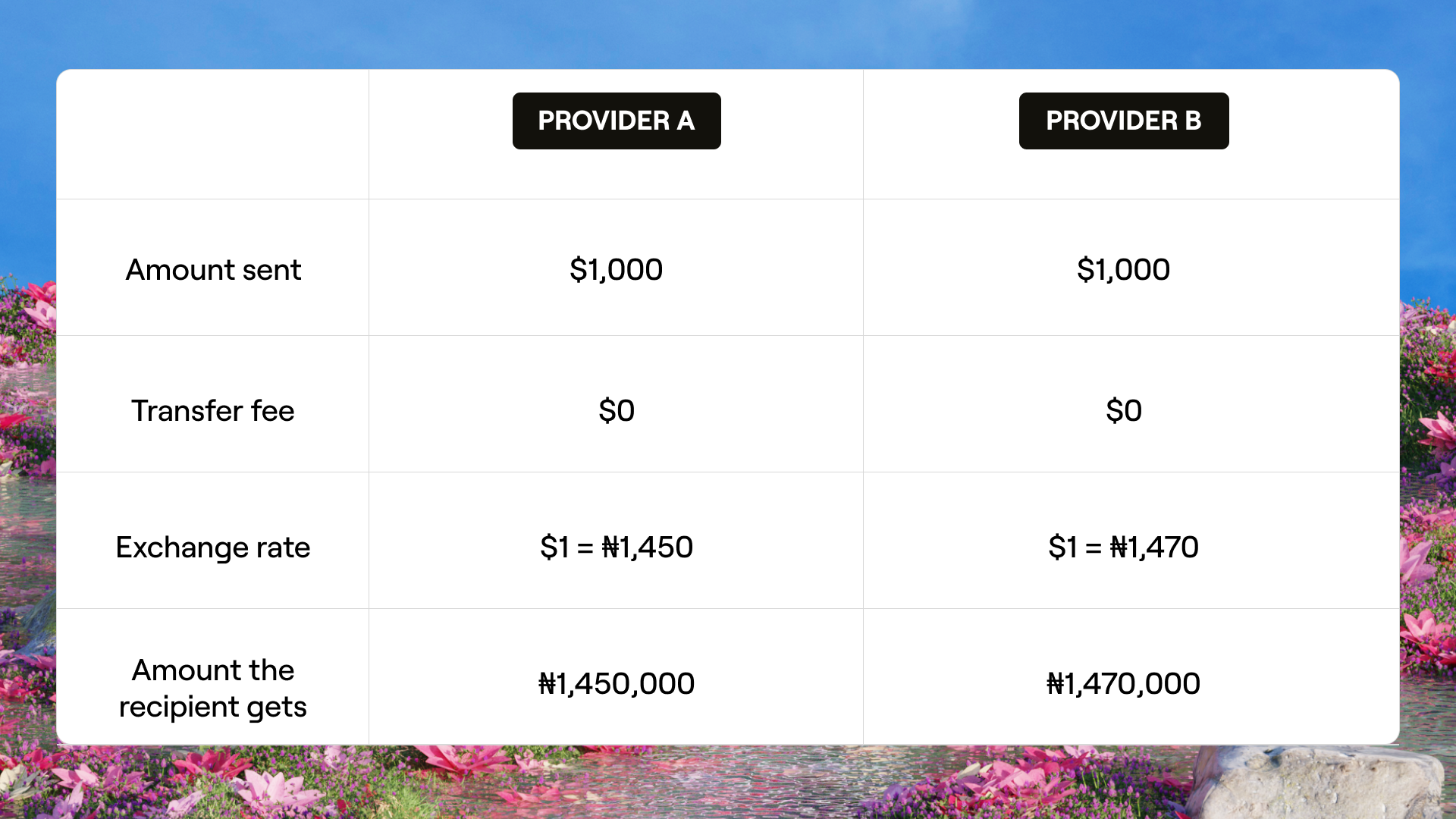
The figures are examples, not current rates or prices from real providers.
Neither provider charges a transfer fee, but the recipient gets ₦20,000 more through Provider B because of its better exchange rate. Someone who compared only the transfer fees would see the two providers as the same.
Other charges on an international transfer
Not every transfer has these charges. Which ones apply depends on how the payment is made and whether the sender or the recipient pays the fees.
Intermediary bank fees
When the sender's bank and the recipient's bank don't have an account with each other, the payment can pass through one or more intermediary banks. These banks may charge a fee, so the recipient gets less than the sender sent.
Recipient bank fees
The recipient's bank may charge a fee when an international payment comes in. The recipient then gets less than the sender expected.
Conversion and withdrawal fees
When the money goes into a digital wallet or an account in another currency, the recipient may pay to convert it or to withdraw it to a bank account.
How to compare the cost of international transfers

Check the same things for each provider you're comparing:
- Total cost: The transfer fee and any other charges the provider lists.
- Exchange rate: The rate the provider gives you, compared with the mid-market rate.
- Amount received: How much the recipient gets in their currency when you send the same amount to the same country.
- Bank fees: Whether intermediary or recipient bank fees apply, and whether the provider can tell you the amounts before you confirm.
Check each provider's rate and fees at about the same time, because exchange rates change. A rate you saw last week may be different today. Some providers offer a better rate or a free transfer for a limited time. Check whether the offer ends after a set date, covers only your first transfer, or applies to only one payment method.
Some services don't charge a fee when you send money to another account on the same platform in the same currency. That's different from a transfer that converts dollars to naira and sends the naira to a bank account. When you see a zero-fee offer, check what the offer covers and what you pay at each step. Our international transfer checklist lists what else to check before you send money.
Checking the rate in the Juicyway app
In the Juicyway app, you can send dollars, pounds, and euros to bank accounts that accept those currencies. You can send Canadian dollars by Interac e-Transfer using the recipient's email address, and the recipient needs an account at a Canadian bank or credit union. When you convert between your currencies, the app shows the exchange rate and the amount you'll get before you confirm. You can compare both with other providers first.
You can also send naira to a Nigerian bank account straight from your USD, pound, or euro balance. The app converts the money as part of the payment and shows the exchange rate and the amount the recipient will get before you confirm.
Where we're licensed, you can also convert and send stablecoins such as USDT and USDC in the Juicyway app. Sending stablecoins to a wallet outside Juicyway can include a network fee, so check the full cost before you send.
Key terms
Exchange rate: The price of one currency in another currency, such as how many naira you get for $1.
Intermediary bank: A bank that passes a payment between the sender's bank and the recipient's bank when the two don't have an account with each other.
Markup: An extra amount a provider adds to the exchange rate.
Mid-market rate: The midpoint between a currency's buying price and its selling price.
Transfer fee: A separate charge a provider takes for making a transfer.
Frequently asked questions
Who pays the bank fees on an international transfer?
The sender chooses who pays when they make a bank transfer. The sender's bank usually offers three options: OUR, where the sender pays all the charges and the recipient should get the full amount; SHA, where the sender pays their bank's charge and the recipient pays their own bank's charges; and BEN, where the recipient pays all the charges out of the amount sent. Under SHA and BEN, intermediary banks may also take fees out of the amount sent.
What's the difference between a transfer fee and a foreign transaction fee?
A transfer fee is a charge for sending money. A foreign transaction fee is a charge a card provider makes when you use your card in another country or pay in a foreign currency. It's usually a percentage of the payment.