



A US bank usually offers two ways to make a transfer: ACH or a wire. Both move money from one bank account to another. They differ in which accounts the sender can reach, how quickly the money arrives, and what the sender pays.
In short
- ACH, the Automated Clearing House network, reaches accounts at US banks. It doesn't reach a Nigerian bank account.
- A wire can be used for an international payment, so it reaches a Nigerian bank. It costs more than ACH.
- An ACH credit arrives the same banking day, the next banking day, or at most two banking days later. Nacha rules don't allow longer.
- A Juicyway USD account comes with a US account number and a routing number, so a sender in the US pays into it as a domestic US transfer.
- A wire to a Nigerian bank passes through correspondent banks, and each bank that handles it can charge for doing so.
What's the difference between ACH and a wire transfer?
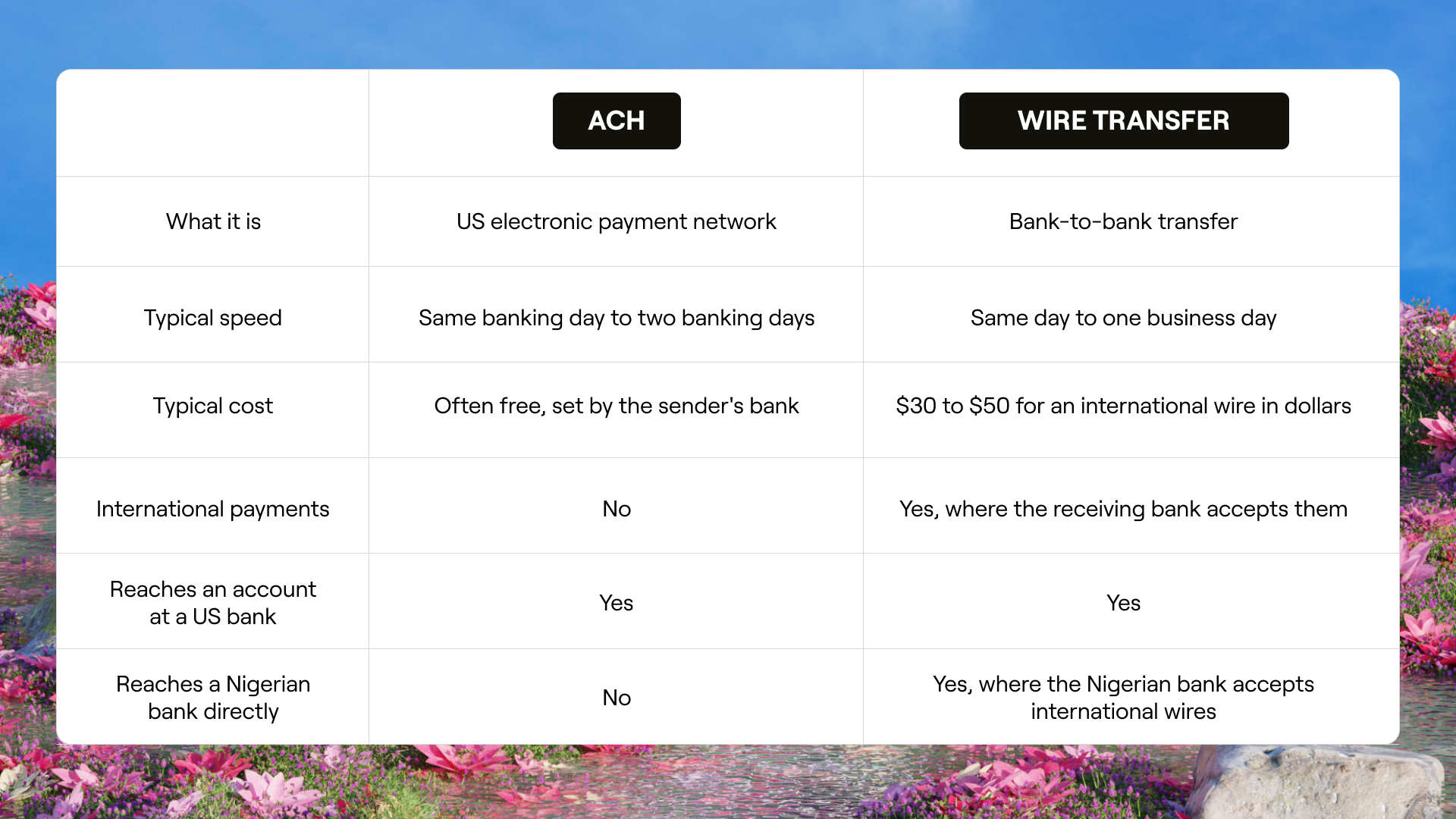
ACH only works between US bank accounts. A wire can be used for a domestic transfer or an international one. So the choice isn't only about price and speed. It's about whether the sender can reach the recipient's account at all.
Can you send money to Nigeria by ACH?
Not to a Nigerian bank account. ACH is a US payment network, so the receiving account has to be at a US bank.
A Juicyway USD account is a US account with a US account number and a routing number, the nine-digit number that identifies a US bank for electronic payments. A sender in the US puts those details into their own bank's transfer screen and sends dollars by ACH. The dollars arrive in the recipient's USD account without leaving the US banking system.
The route:
US bank > ACH > US receiving account > recipient in Nigeria
That's a different route from an international wire to a Nigerian bank, where the payment passes through one or more correspondent banks before the recipient's bank receives it.

How does a wire transfer reach Nigeria?
A wire can be used to send money internationally. Dollars sent from a US bank to a Nigerian bank usually pass through one or more correspondent banks, the banks that pass an international payment along on behalf of the sender's bank.
The route:
US bank > correspondent bank(s) > Nigerian bank > recipient
Each bank that handles the payment can charge for doing so, and some take that charge out of the payment itself. The recipient can therefore receive less than the sender sent.
Every one of those banks also processes the payment during its own working hours. A wire made late on a Friday in New York is processed by each remaining bank when that bank next opens.
Is ACH cheaper than a wire transfer?
Usually. Banks set their own charges, and many don't charge for an ACH transfer between US accounts. An international wire is the expensive option. For a consumer wire sent in US dollars, Chase charges $40 online and $50 through a banker, Bank of America charges $45, and Wells Fargo charges $30 for a digital wire and $40 in a branch. On a $500 transfer, a $45 wire fee is 9% of the amount sent, before anything the correspondent banks take.
All three charge little or nothing for an international wire sent in the recipient's local currency instead of dollars. The bank takes its charge in the exchange rate instead, so the fee the sender sees isn't the full cost of the transfer.
That doesn't make ACH the right choice every time. A wire makes sense when the money is needed quickly, or when the payment has to reach a Nigerian bank account. Check your own bank's published fee schedule before you choose, because fees differ by bank and by account type.
Which arrives faster, ACH or a wire?
A wire. For a transfer into a Juicyway USD account, an ACH credit arrives the same banking day, the next banking day, or at most two banking days later, and a wire arrives the same day. An international wire to a Nigerian bank takes longer, depending on how many banks handle it and when the sender makes the transfer.
There's a third option on the US side. A dollar transfer into a Juicyway USD account can arrive in as quickly as a few seconds, any day of the week including weekends, when the sender's bank or payment provider routes the transfer through FedNow, a US payment system that moves money between banks in seconds at any hour.

What happens on a transfer above $10,000?
Crossing $10,000 doesn't by itself trigger anything. The figure comes from the Currency Transaction Report, which US financial institutions file for cash transactions above $10,000 in one business day. Cash here means physical notes and coins. An ACH transfer or a wire from a bank account isn't a cash transaction.
What applies to a wire is recordkeeping. US financial institutions have to collect and keep information about the sender, the recipient, and the payment itself for funds transfers of $3,000 or more, domestic and cross-border. A bank can also ask the sender for more before it processes a large payment: the purpose of the transfer, the relationship between sender and recipient, and the source of the funds.
Large transfers are ordinary. Businesses make them every day. Allow extra time, and have your documents ready before the bank asks for them.
What to compare before you send
- Where the money is going: a recipient with an account at a US bank can be paid by a US transfer. A recipient with only a Nigerian bank account needs a payment route that reaches Nigeria.
- How quickly it's needed: an ACH credit takes up to two banking days. A wire arrives the same day. An international wire to a Nigerian bank takes longer.
- What the transfer costs in full: the sender's fee is one part of it. The correspondent banks can also charge for handling an international wire, and the bank that converts dollars to naira takes its charge in the rate. A low fee doesn't mean the recipient receives more.
What if the recipient only has a Nigerian bank account?
ACH isn't the route. The US ACH network reaches accounts at US banks.
A wire can be used instead, where the Nigerian bank accepts incoming international wires. The sender generally needs the recipient's account number, the bank's SWIFT code, which identifies it on the international network banks use to send payment instructions across borders, and the bank's address. Each correspondent bank that handles the payment can charge for doing so. Where the recipient wants naira, their Nigerian bank converts the dollars at that bank's rate.
What changes when the recipient has a US dollar account
A US dollar account with US banking details gives someone in Nigeria a way to receive dollars from the US without an international wire. The sender makes a domestic US transfer to that account, and the recipient keeps the dollars or converts them to naira later.
The route changes from:
US bank > international wire > correspondent banks > Nigerian bank
to:
US bank > ACH, wire, or FedNow > US receiving account > recipient
A Juicyway USD account is one of these. It comes with a US account number and a routing number, so a sender in the US pays into it the way they'd pay into any US account. The recipient converts dollars to naira at the rate the app shows, whenever they choose, and sends naira to any Nigerian bank account.
Key terms
ACH: the Automated Clearing House network, used for electronic transfers between US bank accounts.
Wire transfer: a bank-to-bank transfer that can be used for a domestic or an international payment.
Routing number: the nine-digit number that identifies a US financial institution for electronic payments.
SWIFT code: the code that identifies a bank on the international network banks use to send payment instructions across borders.
Correspondent bank: a bank that processes an international payment on behalf of another bank, and charges for doing so.
FedNow: the Federal Reserve payment system that moves money between US banks in seconds, at any hour of any day.
Currency Transaction Report: the report US financial institutions file for cash transactions above $10,000 in one business day, under the Bank Secrecy Act.
Frequently asked questions
Can I send money to Nigeria by ACH?
Not to a Nigerian bank account. ACH reaches accounts at US banks, so it works where the recipient has one, such as a Juicyway USD account with a US account number and a routing number.
Why would I use a wire instead of ACH?
A wire makes sense when the money is needed the same day, or when the payment has to reach a Nigerian bank account rather than an account at a US bank.
How long does an ACH transfer take?
An ACH credit arrives the same banking day, the next banking day, or at most two banking days later. Nacha rules don't allow longer.
How long does a wire transfer take?
A wire into a Juicyway USD account arrives the same day. An international wire to a Nigerian bank takes longer, depending on how many banks handle it.
Is ACH safer than a wire transfer?
Both are established payment methods. A wire is hard to reverse once made, so check the recipient's details before confirming. An ACH payment can sometimes be recalled, and the outcome depends on the banks involved.
Does a transfer above $10,000 get reported?
Crossing $10,000 doesn't by itself cause a report. The $10,000 report covers cash transactions. US financial institutions keep records of funds transfers of $3,000 or more, and a bank can ask for documents before it processes a large payment.