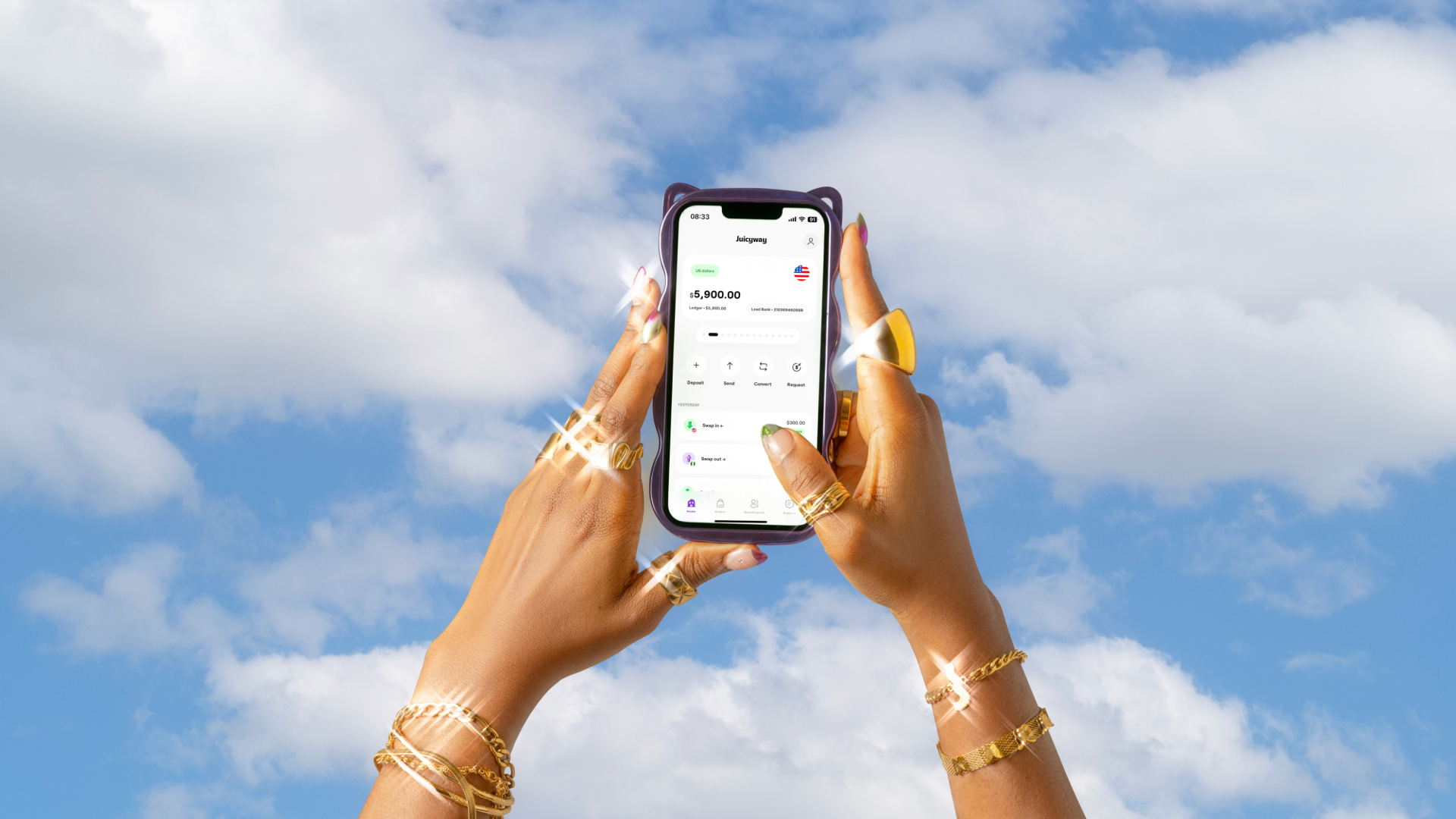



Your F-1 visa doesn't stop you from sending money to Nigeria, and you don't need a Social Security Number (SSN) to do it. You don't need a US bank account either. A Juicyway USD account comes with a US account number and routing number, so dollars can be sent straight to it.
In short
- F-1 rules cover your enrollment and your work. They don't cover sending your own money abroad, and no US law caps the amount you can send.
- F-1 students qualify for an SSN only with work authorization. You don't need one to send money, or to open a bank account at many banks.
- You don't need a US bank account. A Juicyway USD account is a US account, so dollars can be sent straight to it.
- The $10,000 reporting rule applies to cash, not to a transfer from an account.
- Since January 1, 2026, a 1% federal tax applies to transfers funded with cash, a money order, or a cashier's check. Dollars only ever reach a Juicyway account electronically, so that tax doesn't apply.
- Once the dollars are in your USD account, send them to your recipient or convert to naira first and send the naira to any Nigerian bank account.
Does your F-1 visa stop you from sending money to Nigeria?
No. F-1 rules cover where you study, staying enrolled full-time, and what work you can take. Your own money isn't on that list, and no US law caps the amount you can send abroad. Your bank may set its own transfer limits, though that's a bank's own policy, not a legal cap.
Where the money came from is a different question. If you earned it in the US, the work needs to be authorized: an on-campus job, Curricular Practical Training (CPT), or Optional Practical Training (OPT). If you aren't sure whether a job qualifies, your school's designated school official (DSO) can tell you.
Do you need a Social Security Number to send money?
No. Employers use an SSN to report your earnings, so you qualify for one only with work authorization. Without a job offer or a training placement, the Social Security Administration won't issue you one. If you aren't eligible and you need a number for tax purposes, you can apply to the IRS for an Individual Taxpayer Identification Number (ITIN).
None of that applies to sending money. An SSN isn't legally required to open a US bank account, and it isn't required to send money abroad.

Do you need a US bank account?
No. A Juicyway USD account is a real US account, and it comes with a US account number and routing number. Dollars can be sent straight to it, and you send from that account.
If you want a US bank account as well, most banks ask for your passport, your I-20, your I-94 arrival record, and proof of a US address such as a housing letter or a lease. Your school issues the I-20 to confirm that you're enrolled and eligible for F-1 status, and the I-94 is the record of your entry into the US. Some banks want a second form of identification, like your student ID. Policies differ from bank to bank. Some branches ask for an SSN or an ITIN, and others accept a passport number or a tax number from your home country instead, so call ahead and ask whether they open accounts for international students without an SSN. If you have neither number, the bank may ask you to complete Form W-8BEN, which is how you confirm that you're a foreign person for tax purposes.
Will a large transfer be reported?
Not automatically. The $10,000 reporting rule applies to cash.
A Currency Transaction Report covers physical currency, so paying more than $10,000 in notes across a counter triggers one, and an electronic transfer doesn't. What applies to your transfer is recordkeeping: banks keep records of transfers of $3,000 or more, and they can report activity that looks unusual at any amount. Keeping a record isn't the same as reporting you, and sending a large amount is legal.
How you fund the transfer changes what you pay
Since January 1, 2026, a 1% federal excise tax applies to money sent abroad from the US when you fund the transfer with cash, a money order, or a cashier's check. You pay it as the sender, and the provider collects it when you send.
Transfers funded electronically are exempt, including transfers funded from a US bank account or a US debit or credit card. Dollars reach a Juicyway account electronically, either sent to your USD account details or converted from another currency in the app, so a transfer you send from a Juicyway account isn't cash-funded.
Send dollars, or send naira
You sign up on Juicyway, verify your identity, and request a USD account. It comes with a US account number and routing number, so dollars can be sent to it the same way they'd be sent to any US account. If you already have a US bank account, you can move dollars across from it: a bank transfer (ACH) takes one to three business days, and a wire goes through the same day.
Once the dollars are in your USD account, you have two options. You can send the dollars to your recipient's Juicyway account and let them convert to naira when the rate suits them. Or you can convert to naira yourself at the rate the app shows, and send the naira to their Juicyway naira account or to any other Nigerian bank account.
Juicyway isn't a bank. It's an app for keeping, swapping, and sending money in different currencies, licensed in the US and regulated in every country it works in: the US, the UK, Canada, and Nigeria. Juicyway runs its payments on stablecoins behind the scenes, which keeps the cost down.

What you need to send
To send from the US, you need a Juicyway USD account with dollars in it.
What you need from your recipient depends on how you finish. If you send dollars, you need their Juicyway details. If you send naira, you need the details of the account they want it in, which can be their Juicyway naira account or any Nigerian bank account.
Key terms
- Social Security Number (SSN): A US number employers use to report your earnings. F-1 students qualify for one only with work authorization.
- Individual Taxpayer Identification Number (ITIN): A number the IRS issues to people who aren't eligible for an SSN but need one for tax purposes.
- Form I-20: The certificate of eligibility your school issues through the Student and Exchange Visitor Information System (SEVIS). It confirms that you're enrolled and eligible for F-1 status, and banks use it to check your status.
- USD account: A US dollar account you open in the Juicyway app. It comes with a US account number and routing number, so dollars can be sent straight to it.
- Remittance transfer tax: A 1% federal tax on money sent abroad from the US when the transfer is funded with cash, a money order, or a cashier's check. Transfers funded electronically are exempt.
- Currency Transaction Report: The report a bank files for cash transactions over $10,000. It covers physical currency, not transfers from an account.
Frequently asked questions
Can I send money to Nigeria on an F-1 visa?
Yes. F-1 rules cover your enrollment and your work, not what you do with your own money, and no US law caps how much you can send abroad.
Do I need a Social Security Number to send money to Nigeria?
No. An SSN isn't legally required to open a US bank account, and it isn't required to send money abroad. F-1 students qualify for an SSN only with work authorization.
Do I need a US bank account to send money to Nigeria?
No. A Juicyway USD account comes with a US account number and routing number, so dollars can be sent straight to it, and you send from that account.
Is a transfer over $10,000 reported to the IRS?
Not automatically. The $10,000 report covers cash transactions, not an electronic transfer. Banks keep records of transfers of $3,000 or more, which is recordkeeping rather than a report about you.
Does my recipient need a Juicyway USD account?
Not always. If you convert to naira before you send, the naira can go to any Nigerian bank account. They need a Juicyway USD account only if you send dollars for them to convert themselves.
Make your first transfer
You don't need an SSN, and you don't need a US bank account. Your Juicyway USD account is a US account, so dollars can be sent straight to it. From that account, you send dollars to your recipient or naira to any Nigerian bank account.
Download Juicyway on the App Store or Play Store and sign up.